
Sport Pilot and Light Sport Category Aircraft - The Basics
Before we get started, this Sport Pilot and Light Sport Category Aircraft can be very confusing.
The first and most important concept is there are two important distinctions that need to be understood.
First and foremost: All the rules are for two completely different things, Pilot and Aircraft.
- Sport Pilot is for a person, a pilot, a human.
- Light Sport is for an Aircraft made of steel, aluminum, fiberglass, composite, wood, wire, etc.
You may hear people confusing this by saying Light Sport Pilot. No such thing. The FAA regulations address both Pilot and Aircraft differently as separate rules.
Although the Pilot and Aircraft are closely connected, much of the confusion comes from combining the Pilot and Aircraft and not thinking of them as separate items. This is the first concept to understanding these rules.
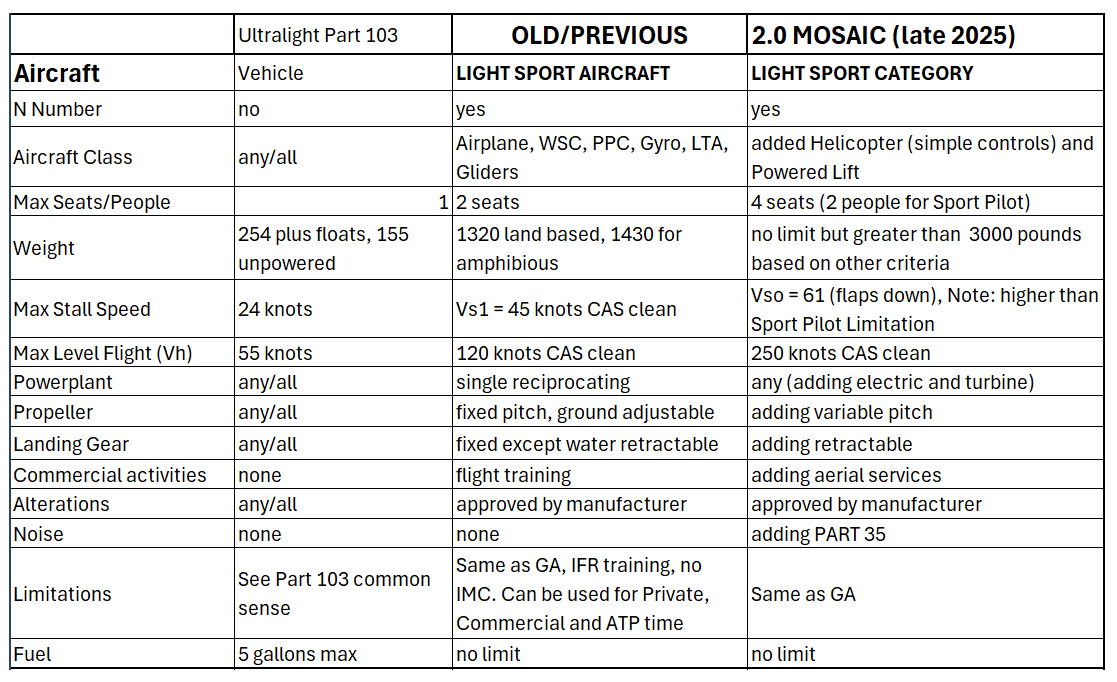
The following charts summarize the versions SP/LSA 1.0 and MOSAIC.
Ultralights added here so no confusion as to what an Ultralight is.
2025 FAA Sport Pilot and LSA MOSAIC (Modernization of Special Airworthiness Certificates
-
SP/LSA or Sport Pilot/Light Sport Category Aircraft 1.0 – We had Sport Pilot/Light Sport Aircraft for the period 2004 through late 2025.
This was the introduction to enhanced privileges for pilots and introduction to less regulated aircraft. Pilots could fly Light Sport Aircraft without a FAA medical.
Manufacturers could produce aircraft with less FAA control by self certification with FAA oversight, approval and monitoring. This was a huge success for Pilots and Aircraft which has led to the new/enhanced MOSAIC.
MOSAIC (Modernization of Special Airworthiness Certification) or Sport Pilot/Light Sport Category Aircraft 2.0 – Now we have Sport Pilot/Light Sport Category for the period beginning October 22, 2025.
This further increases the Pilot capability to fly faster and more complex aircraft. Additionally, the manufacturers aircraft self certification can be faster, have more seats, and be more complex.
This will allow more pilots to fly more existing and newly developed aircraft and allow the manufacturers to develop faster, more efficient aircraft at lower cost.
MOSAIC is greatly expanded for both Pilots and Aircraft.
SP/LSA 1.0 separated Pilots and Aircraft and the connection was that Sport Pilots and above (Private, Commercial and ATP) could fly Light Sport Aircraft, they were qualified in, as a Sport Pilot using a US drivers license as the medical eligibility, not needing an FAA medical. This was a direct link that Sport Pilots could fly Light Sport Aircraft. Now with MOSAIC, Sport Pilots can not fly all Light Sport Aircraft.
With MOSAIC, there are specific limitations for the Sport Pilot, and there will be faster Light Sport Aircraft the Sport Pilot can not fly. This further separates the Sport Pilot and the Light Sport Aircraft.
Sport Pilot

Light Sport Category Aircraft

Category, Class, and Type
It should be understood that we are focusing on Airplane and Weight-shift Control categories. But a broad range is provided in this section to understand the concepts for the typical sport pilot.
- Category is the biggest grouping based on aircraft use, like airplane, weight-shift control, glider, lighter than air or rotorcraft.
- Class narrows it down by design, like single-engine land or single engine sea.
- Type refers to a specific make and model, like a Boeing 737, requiring a type rating in some cases. Not applicable to sport pilots.
“Category” has different meanings in pilot certification and aircraft certification but a simplistic chart is presented here as an example.

What is a Sport Pilot certificate?
A sport pilot certificate is issued by the FAA and allows the holder to fly many light sport aircraft. It was created in 2004 to make flying more accessible, with reduced training time, medical requirements, and cost.
The requirements to earn a sport pilot certificate have not changed under MOSAIC rules. A sport pilot must:
- Be at least 17 years old.
- Read, speak, write, and understand English.
- Hold a valid U.S. driver’s license, or medical certificate. (See more information on medical requirements below.)
- Have a minimum of 20 hours of flight time, including:
- 15 hours of flight training from an authorized instructor.
- 5 hours of solo flight.
- 2 hours of cross-country flight training.
- 10 takeoffs and landings to a full stop.
- One solo cross-country flight of at least 75 nautical miles total distance with a full-stop landing at a minimum of two points and one segment of the flight consisting of a straight-line distance of at least 25 nautical miles between takeoff and landing locations.
- 2 hours of flight training in preparation for the practical test.
- Ground training from an instructor or home-study course.
What is a Light Sport Category Aircraft?
A Light Sport Aircraft (LSA) was defined, previous to MOSAIC, as an aircraft that had to meet strict limitations, including max takeoff weight, max airspeed, max stall speed, and more.
Since the definition of LSA was removed, there are new requirements for certification.
A stall speed limitation replaces the weight limit, allowing a more expansive range of design options and performance for light-sport category aircraft issued airworthiness certificates on or after July 24, 2026 based on industry consensus standards.
More information can be found under “What is changing for light sport aircraft?” below.
Do I need a license to fly a Light-Sport Category Aircraft?
You must obtain a Sport Pilot Airman Certificate or a Private Pilot airman certificate if you wish to fly a two-seat Light-Sport Aircraft. Single-seat ultralight vehicles are less regulated and more clearly defined under the Federal Aviation Regulations Part 103, where a license is not required.
As a Sport Pilot, where and when can I fly?
At almost all airports in the U.S. with proper endorsements, during daytime only (and during civil twilight with aircraft position lighting), at altitudes below 10,000 feet MSL (and above 10,000 feet MSL at 2,000 feet above ground level), with visual reference to the ground. Specifics for sport pilots are listed in FAR Part 61.315 and FAR Part 61.316.
There’s no distance limitation (can be anywhere in the U.S.). As long as a private pilot is current and has a medical, the private pilot can fly an LSA at night or in Instruments if pilot-rated and the airplane is properly equipped.
Is a Sport Pilot trained to lower standards than a Private Pilot?
No. The piloting and mastery of the aircraft, stick and rudder skills are the same.
The difference is in the additional private pilot experience at larger towered airports communicating with “air traffic control”, flying at night, radio navigation (which few pilot use now with modern GPS’s) and flying above 10,000 feet with oxygen.
What is the difference between the 20-hour minimum sport pilot flight training hours and the 40-hour minimum private pilot training hours?
Less training is required because there is no night flight training, high altitude procedures above 10,000 feet, control tower operations and radio navigation/VOR requirements.
However, Sport Pilots can receive additional training (beyond the 20 hours minimum required training for Sport Pilots) and be endorsed to operate at larger control towered airports.
What are the medical requirements for a Sport Pilot?
First and foremost, same as all pilots flying any aircraft, you must personally determine before each flight you are medically fit to operate the aircraft in a safe manner.
Second, a valid U.S. driver’s license can be used for medical eligibility in which the same restrictions on a driver’s license, such as wearing glasses, are applicable when flying an airplane LSA as a sport pilot.
It should be noted that if an FAA third-class medical was suspended, denied, or revoked, this must be cleared before using a driver’s license as medical eligibility to fly as a sport pilot. Private pilots should simply let their third-class medical expire and use their driver’s license as medical eligibility rather than failing an FAA medical exam and having to go back to clear it.
A third-class medical can also be used as medical eligibility for a Sport Pilot in place of a driver’s license for medical eligibility along with a government-issued photo ID in place of a using a single current driver’s license.
Overall, for many reasons, a medical should be avoided. However, if you want to know more about the FAA medical, see FAA Medical.
What is MOSAIC?
The FAA Modernization of Special Airworthiness Certification (MOSAIC) rule, published in the Federal Registry on July 24, 2025. Some changes took effect in October 2025, while others will take effect in July 2026.
MOSAIC amends rules for the manufacture, certification, operation, maintenance, and alteration of light-sport aircraft.
The amendments enable enhancements in safety and performance and increase privileges under a number of sport pilot and light-sport aircraft rules.
These enhancements include increasing suitability for flight training, limited aerial work, and personal travel.
This final rule expands what aircraft sport pilots may operate. This final rule also amends the special purpose operations for restricted category aircraft; amends the duration, eligible purposes, and operating limitations for experimental aircraft; and adds operating limitations applicable to experimental aircraft engaged in space support vehicle flights to codify statutory language.
In other words, MOSAIC expands sport pilot privileges, allowing certificate holders to fly more types of aircraft than before. It also expands the types of aircraft that are now considered light-sport category aircraft by removing the weight limit and instead limiting them by stall speed.